 Open the full-size preview
 Open the full-size preview
Track current positions rather than reconstruct trades
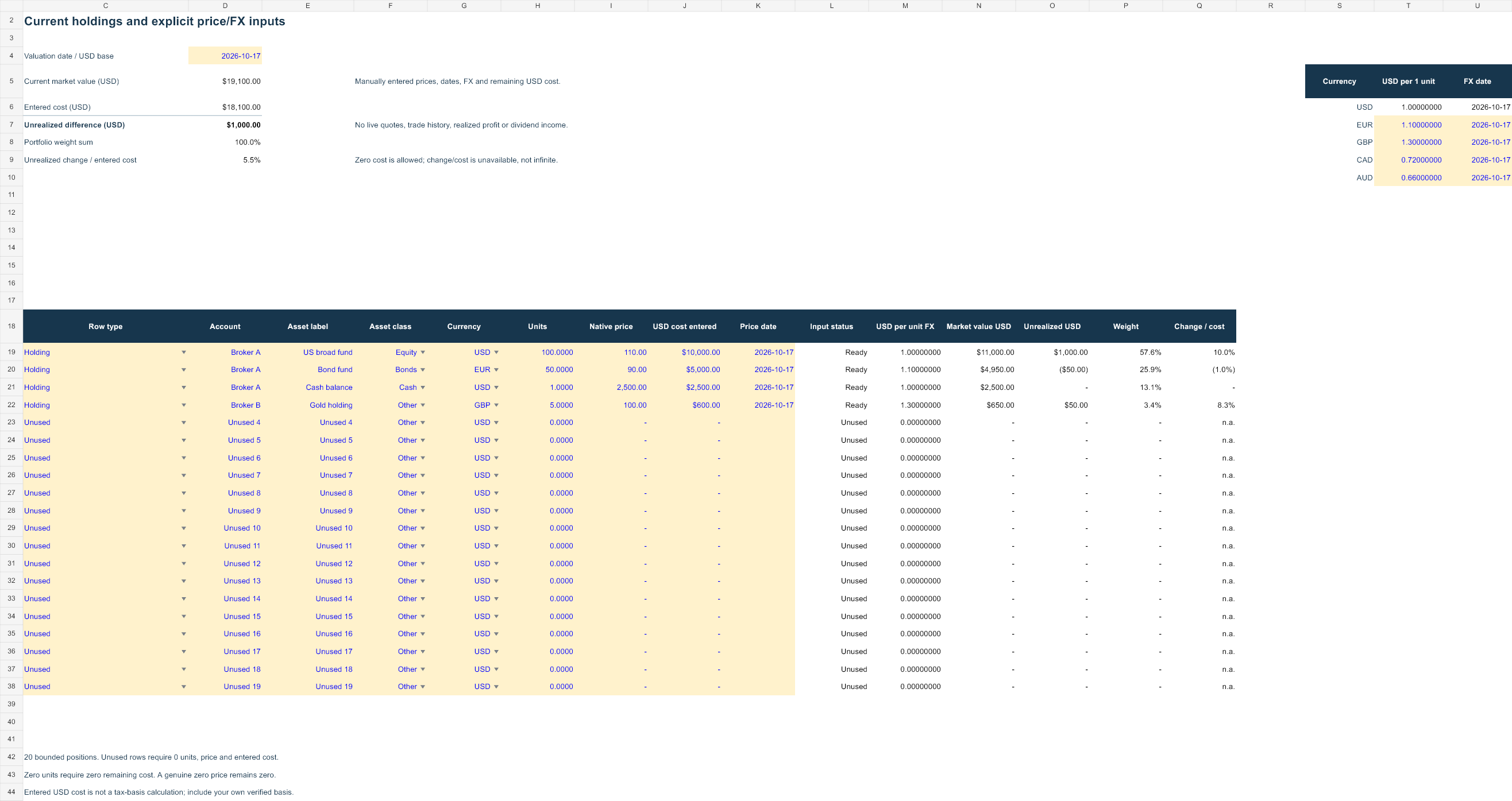
Holdings contains twenty bounded positions. Enter a row type, account, asset label, one of four asset classes, currency, units, current native price, remaining USD cost and price date. The account/asset key must be unique among holdings. A position can use fractional units; a zero-unit position must have zero remaining entered cost.
The class labels are Equity, Bonds, Cash and Other. They are reporting buckets, not product recommendations. Cash can be recorded as one unit at the cash balance price, as the example illustrates. An unused row requires zero units, price and cost. A genuinely worthless asset can have a zero price, which preserves the negative unrealized difference instead of treating it as missing.
Translate current value explicitly
Market value in USD is units times native price times the displayed USD-per-unit currency rate, rounded to cents per position. Price and FX dates must not be after the snapshot date. The five-currency rate table is entered manually. A price from an earlier date and the FX date remain visible; this is not a live consolidated quote.
Unrealized difference is current USD market value less the USD cost you entered. The file does not construct cost basis from trades, lots, fees, splits or reinvestments. The entered cost should come from your own verified remaining-cost records. With zero cost, the change/cost ratio is unavailable rather than infinite.
Reproduce the invented holdings
The equity example is 100 units at USD 110, worth USD 11,000 against USD 10,000 entered cost. The bond example is 50 units at EUR 90 with 1.10 FX, worth USD 4,950 against USD 5,000 cost. Cash is USD 2,500; the GBP other holding is worth USD 650 against USD 600 cost.
Total market value is USD 19,100 and entered cost is USD 18,100, so unrealized difference is USD 1,000. The apparent 5.5% displayed change/cost excludes realized trades, distributions and cash-flow timing. It is not total return, annualized performance or a tax-basis calculation.
Compare allocation with your own targets
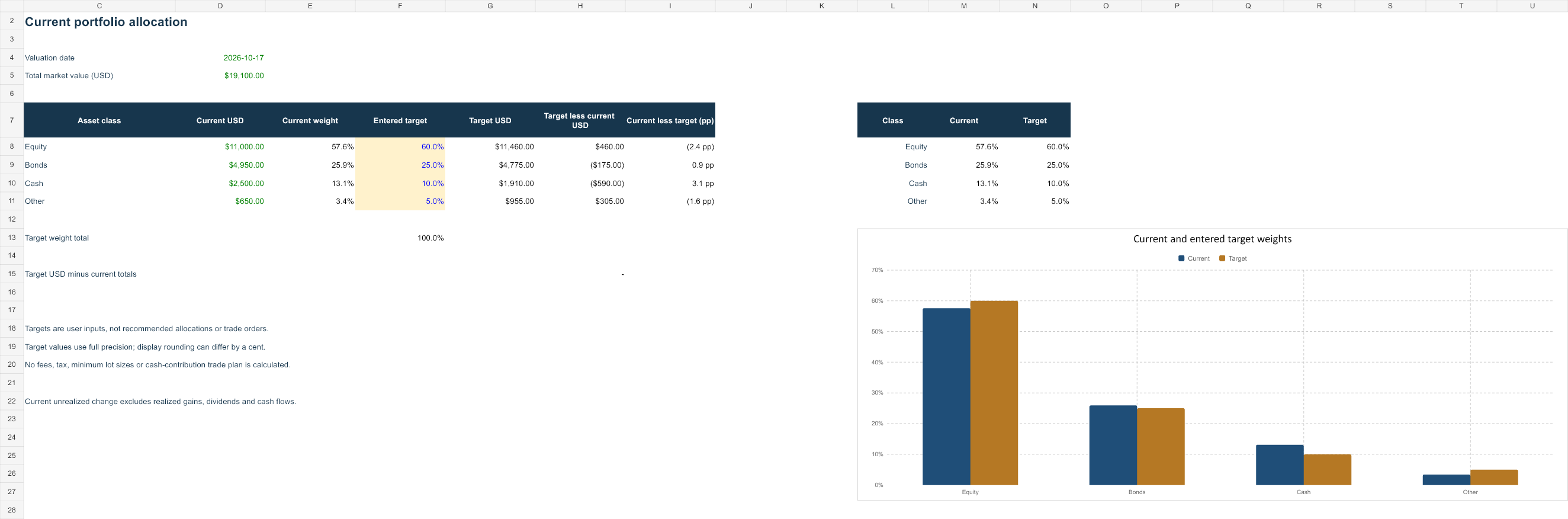
Allocation links the completed holding values into four asset-class totals and weights. Enter four target percentages that sum to 100%. A missing target or an invalid total makes the target illustration unavailable. The invented targets are 60%, 25%, 10% and 5%; they are examples rather than a recommended mix.
Target USD equals current total value times the entered target. Target less current is an illustrative value gap; current less target is displayed in percentage points. The example gaps are USD 460, negative USD 175, negative USD 590 and USD 305. Values use full precision, so display rounding can differ by a cent.
This is not an executable rebalancing plan. It does not include transaction costs, tax consequences, minimum lots, future contributions or the cash effects of actual trades. Check the underlying statements and your own circumstances before acting on a target. The workbook’s chart compares the entered targets with current weights; unavailable weights are gaps.
Open, edit and verify your copy
Open in Microsoft Excel and save a dated working copy before replacing blue inputs. Native Excel recalculation, representative edits and save/reopen were checked in disposable copies. Missing required inputs differ from a deliberate zero. Read the row status and restore valid inputs before relying on a complete total.
XLSX can be imported into other spreadsheet applications, but native Google Sheets layout, formulas and charts have not been tested here. Inspect a converted file before using it. Your records stay on your device or chosen storage service; this site does not accept uploads or account credentials. Normal hosting can log page and download requests.
Definitions and primary sources
Investor.gov: Figure out your finances · Investor.gov: Asset allocation and rebalancing · FINRA: Return and rate of return · IRS: Dividends and distributions
Sources provide definition context. Workbook layouts, formulas and all examples are original AllMarkets material, not official agency templates or a tax/financial reporting certification. Sources checked 17 October 2026.