Plan when cash moves
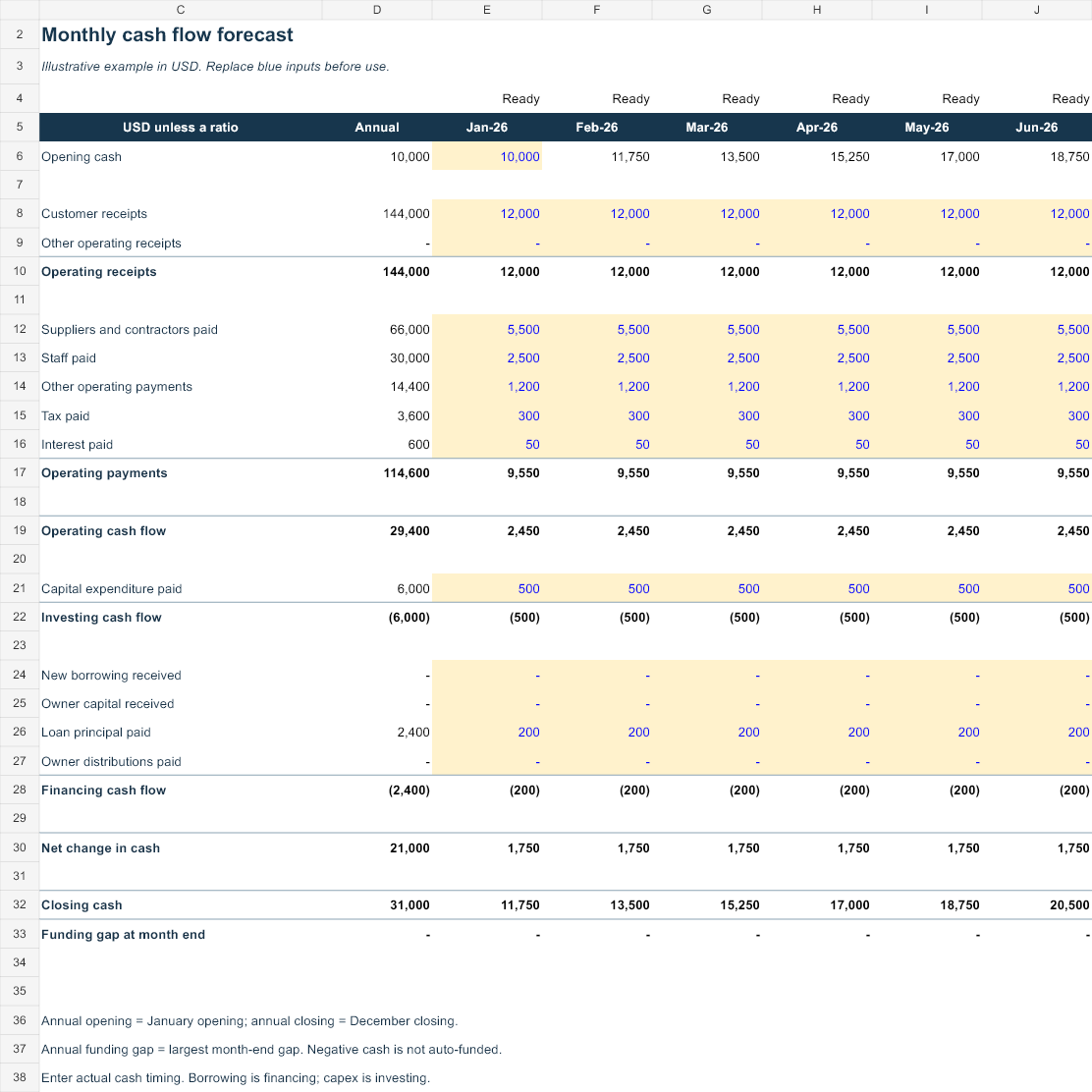
This editable workbook uses the direct receipts-and-payments approach. Enter customer receipts and other operating receipts in the month money is expected to arrive. Enter suppliers, staff, other operating costs, tax and interest in the month money is expected to leave. These are cash timings, not necessarily the revenue and expense periods in your P&L.
Capital expenditure is shown separately as investing cash flow. Borrowing and owner contributions are financing inflows. Loan principal and owner distributions are financing outflows. This classification keeps a loan receipt from looking like sales and a loan repayment from being confused with interest expense.
Opening, movement and closing cash
Enter opening cash in January. Each later opening balance links to the preceding month's closing balance. Operating cash flow, investing cash flow and financing cash flow sum to the net change. Opening cash plus that change produces closing cash.
The Annual column sums receipts, payments and changes across all twelve months. It uses January's opening cash and December's closing cash for the two balance rows. Summing monthly cash balances would double count the same money and is deliberately avoided. The annual funding-gap row shows the largest month-end shortfall, rather than summing gaps across months.
Reproduce the example
The invented example starts with $10,000. Monthly receipts are $12,000 and operating payments total $9,550, generating $2,450 operating cash. After $500 capex and $200 loan principal, net cash increases by $1,750. December closes at $31,000 when the same pattern repeats for twelve months.
Change the first month's customer receipts to zero. Closing cash becomes negative $250 and the funding-gap row shows $250. The model does not silently introduce a loan, defer a supplier payment or assume an overdraft. A negative forecast requires a real funding or timing decision outside the spreadsheet.
Update the forecast
- Replace opening cash with the actual available balance on your forecast start date.
- Replace every monthly receipt and payment input, using due dates and expected settlement timing.
- Keep debt principal, interest and capex separate.
- Review the earliest month with negative closing cash, even if the year-end balance is positive.
- As actual cash movements become known, update the relevant month and document your assumptions separately.
Limits
There are twelve monthly periods, not a daily liquidity schedule. A month-end positive balance can hide a shortage earlier in the month. The template does not connect to bank accounts or verify that an expected receipt will arrive. Blank required flows make affected calculations unavailable; a genuine zero should be entered as 0. Use one consistent currency and do not combine balances with different exchange-rate assumptions.
Opening and saving the file
Open the downloaded XLSX in desktop Excel and save a copy before editing blue input cells. Formulas, representative input changes and save/reopen were tested in Microsoft Excel. Google Sheets can import XLSX through File → Import → Upload, but native Sheets rendering and recalculation have not been verified. Check formulas and charts after any conversion.
Keep financial records on a device and account appropriate for your business. This website serves the template; it does not receive your edited workbook or connect to a bank.
Definitions and further reading
The SEC introductory guide to financial statements explains why position, earnings and cash describe different financial information. The SBA business-management resources provide broader small-business context. These sources support the definitions; the original workbook layouts and invented examples are AllMarkets material.
Full methodology and limitations · Compare all four templates