Compare financial position on two dates
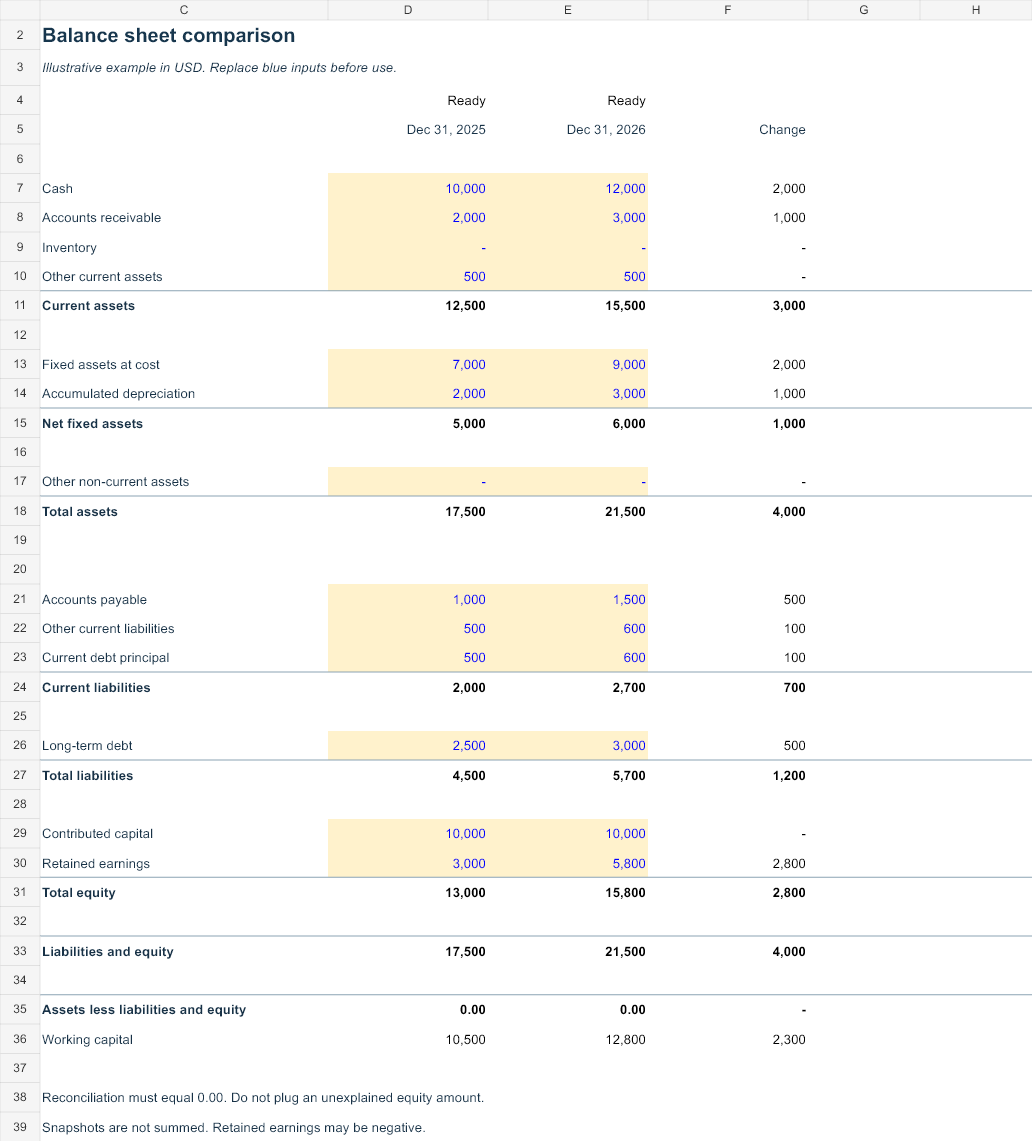
A balance sheet describes a point in time. This workbook shows an illustrative December 31, 2025 snapshot beside December 31, 2026, with a change column. Replace both dates and balances with your own comparable snapshots. Do not sum the two dates or confuse the change column with a complete cash-flow statement.
The asset side separates cash, receivables, inventory, other current assets, fixed assets at cost, accumulated depreciation and other non-current assets. Accumulated depreciation is entered as a positive deduction from fixed asset cost. Current liabilities, current debt principal and long-term debt remain separate from contributed capital and retained earnings.
Reconcile both sides
Assets less liabilities and equity should equal 0.00. The example's earlier total assets and liabilities plus equity are both $17,500. The later snapshot totals $21,500 on each side. Working capital is current assets less current liabilities, giving $10,500 and $12,800 in the two invented periods.
Increase the later cash input by $1,000 without recording its source. The difference becomes $1,000. The template does not hide the discrepancy by adding balancing equity. Trace the related transaction, funding source, retained-earnings change or classification before correcting the underlying balances.
Enter balances carefully
- Use your ledger or reconciled account balances for the two stated dates.
- Keep current and long-term debt classifications consistent with their terms.
- Enter accumulated depreciation as a positive amount no greater than the displayed fixed asset cost.
- Enter retained earnings as signed: a deficit may be negative.
- Confirm both difference cells equal 0.00 and investigate any amount outside rounding tolerance.
What the change column means
A positive change in cash is simply the difference between two cash snapshots. It does not explain operating, investing and financing sources. A change in retained earnings may include net income, distributions and other permitted equity adjustments depending on the business; this standalone sheet does not derive those changes automatically.
Current assets less current liabilities is working capital. It is not a guarantee that all receivables are collectible or that inventory can be converted to cash immediately. A balanced sheet confirms arithmetic consistency, not that valuations are correct or every liability has been recorded.
Limits and missing information
Enter a deliberate zero for an absent line. A blank required numeric input makes derived results unavailable. Negative retained earnings are allowed; the simplified other input categories require non-negative values. Consolidation, foreign currency, complex lease accounting, impairment and statutory disclosures require more detailed accounting work than this template provides.
Opening and saving the file
Open the downloaded XLSX in desktop Excel and save a copy before editing blue input cells. Formulas, representative input changes and save/reopen were tested in Microsoft Excel. Google Sheets can import XLSX through File → Import → Upload, but native Sheets rendering and recalculation have not been verified. Check formulas and charts after any conversion.
Keep financial records on a device and account appropriate for your business. This website serves the template; it does not receive your edited workbook or connect to a bank.
Definitions and further reading
The SEC introductory guide to financial statements explains why position, earnings and cash describe different financial information. The SBA business-management resources provide broader small-business context. These sources support the definitions; the original workbook layouts and invented examples are AllMarkets material.
Full methodology and limitations · Compare all four templates